The practices we all inherited, put under a stress test.
Most of what organizations do with people was designed decades ago and has never been checked. We take one practice at a time, say what the research supports and what it does not, and leave you with one page you can take into your next meeting.
Take feedback. The largest review of it found that feedback lifted performance on average, and lowered it in about a third of cases. Most performance systems are built as though only the first half were true.
How this works
One practice, taken
seriously, at a time.
We pick a practice
Something every organization does and few have examined: a rating scale, a goal cascade, a calibration meeting.
We read what exists
Research where there is research, organizational accounts where there is not, and we say which is which, including what we could not find.
You get a decision, not a lecture
Each article answers its question in one line, states our position, and ends with a page of questions for the room.
What we are working through
Investigations,
one at a time.
Each investigation runs until the questions are answered honestly, then we publish what we found and move on. We would rather finish one than start five.
| Investigation | The question behind it | Status |
|---|---|---|
| Performance management | Do the things we do to manage performance actually improve it, and who is each of them for? | Live, 7 articles |
| Pay and reward | What happens to judgment, effort and trust when money is attached to a rating? | Next |
| Hiring and selection | Which parts of how we choose people predict anything, and which survive because they feel rigorous? | Planned |
| Engagement and retention | What actually keeps capable people, as opposed to what surveys measure? | Planned |
| AI and the shape of work | When the work changes faster than the job description, what should we be managing? | Planned |
The current investigation
Performance
management.
Seven questions, examined in order, from the goals people are set to the decision about what to change.
See all seven questionsInvestigation one
What performance management is actually for
From the goals people are set, through the conversations and the judgment, to the decision about what to keep, change or drop. 7 questions, each answered in one line before the argument starts.
How to read us
Every article says how
solid the evidence is.
Repeated findings, consistent across studies.
A review or meta-analysis, read within its limits.
Organizations describing their own experience.
Serious arguments on both sides, unsettled.
The question is open. We say so.
For your next meeting
One page,
for the room.
Five questions, a framework or a checklist, and a table to fill in. Work through it on screen, or print it and take it with you.
Choose a worksheet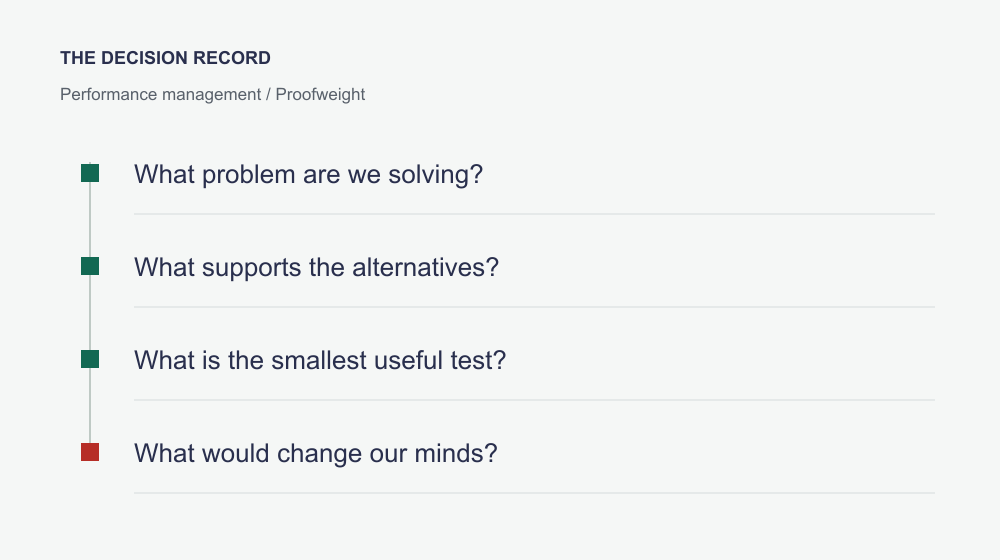
Once a month
One question, what the evidence says, and a tool you can use.
No news, no trends, no roundups. One email a month, and one click to leave.
Questions or corrections
Want to talk through a decision?
Share a practical question, a correction or an example from your organization.